Cambridge
H is for HawkCambridge is more than the academic setting of Helen Macdonald’s memoir: it is a city repeatedly seen through changing states of attention. College rooms and streets initially belong to the routines of scholarship, while lawns, rooftops, and the countryside at the city’s edge become places where grief, falconry, and a developing sense of home reshape what the city means. As Macdonald’s life contracts around Mabel, Cambridge becomes at once an institution, a social world, a view from above, and a landscape intimately known on foot.
City, College, and Countryside
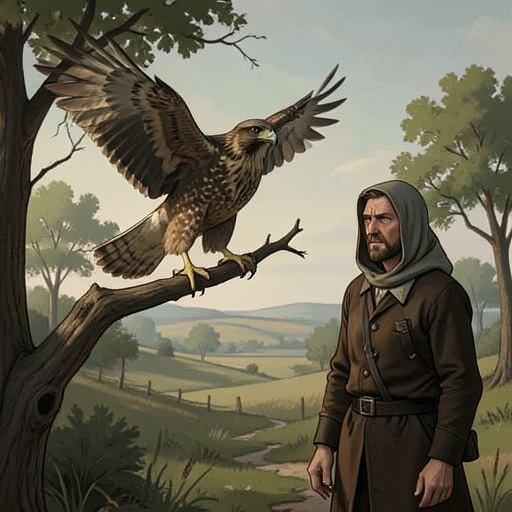
Forty-five minutes north-east of Cambridge lies the Brecklands, where wet fen gives way to dry sand. Macdonald describes this country as a broken landscape of pine forestry, abandoned cars, military bases, and remnants of earlier settlement. Its planes, gas-guns, woodlarks, and jet engines make it neither an untouched wilderness nor merely a backdrop to the city. It is a working, inhabited environment, and the goshawks she hopes to see there are difficult to find: often the forest offers only a sudden hush, alarm calls, or the remains of a pigeon. On a dawn visit, the search draws Macdonald out of her academic life and into a different kind of attention to land.
Cambridge itself is also encountered as a place of work and institutional history. Macdonald has spent months in libraries and college rooms, frowning at screens, marking essays, and pursuing academic references. Her office occupies the upper floor of a red-brick Victorian college building, a place of books, papers, a desk, and the dust-like smell that persists even in winter. Later, when she stands by the college cricket pitch with Mabel, that familiar setting momentarily loses its familiarity: its buildings appear as collections of accumulated objects and histories rather than as a natural home for academic life. The shift is not a change to the buildings themselves but to the way Macdonald can inhabit and interpret them.
Beyond the city, the surrounding countryside becomes a place of concentrated observation. On the Brecklands search, Macdonald finds herself moving cautiously between sunlight and the narrow shadows between pine stands, responding to birds’ alarm calls and approaching a pond where chaffinches, bramblings, and long-tailed tits rise from the edge. The landscape directs her movements before she can fully explain them. The contrast with the desk-bound work of the college is sharp: in the woods, attention is physical and uncertain, shaped by the possibility of seeing a goshawk but also by the need to remain unseen.
Grief and the City’s Ordinary Life
After her father’s funeral, Macdonald returns to Cambridge. She does not sleep, drives around, and watches the sun move across the day while the city continues its ordinary business. Pigeons court on the lawn outside her house; planes land, cars drive, and people shop, talk, and work. Their persistence does not console her. Instead, the continuity of daily life makes the world seem senseless against her father’s death, and she feels as if she is made of metal that burns from within.
The city also brings grief into contact with practical, impersonal systems. Searching for her father’s blue Peugeot near Battersea Bridge, Macdonald and her companions look through streets for hours before understanding that the car has been towed. She phones the compound and explains that its owner cannot collect it because he is dead. The required death certificate settles the fee, but the procedure cannot make the loss signify less or more than it does. This episode belongs to the wider urban geography of the memoir: bereavement enters through an ordinary car, a phone call, and paperwork, while the city’s procedures continue regardless.
Cambridge’s familiar spaces do not shield Macdonald from the disorientation that follows. She describes coincidences and memories seeming to cross the boundary between past and future, and at times feels that her father is sitting nearby on a train or in a café. She reads books about grief in search of explanations. In this account, the city is not simply where sadness occurs; its everyday movement becomes the counterpoint against which her altered sense of time and reality is registered.
Mabel in the Academic World
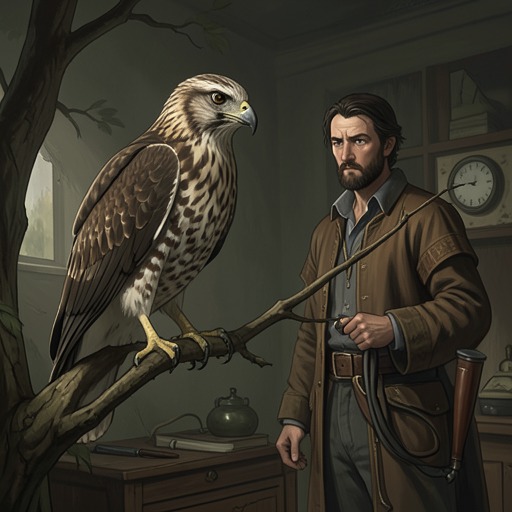
In the summer, Macdonald finds a breeder in Northern Ireland with one young goshawk left from the year’s brood and arranges to drive to Scotland to collect her. Back in Cambridge, the decision turns the house and its rooms into the setting for an intensive training relationship. Macdonald shuts out the outside world, fills the freezer with food for the hawk, and sits with her in a darkened room. The old falconers called this process watching: the falconer remains present and still while the hawk gradually becomes less fearful. For Macdonald, those hours also give life a purpose when other parts of it have become difficult to organize.
Cambridge’s domestic and academic worlds meet when Macdonald begins flying Mabel on the college grounds. At first, the open lawn is a practical training place, but it is also adjacent to the office and the career she has been living. Before a calling-off lesson, she recalls declining a job at a German university. Her letter gives her father’s death and the need to stay as reasons, but her actual resistance is bound up with having a hawk to fly. The decision marks how far her immediate life has been reorganized around falconry: future plans and professional ambition seem remote beside the daily demands of Mabel’s training.
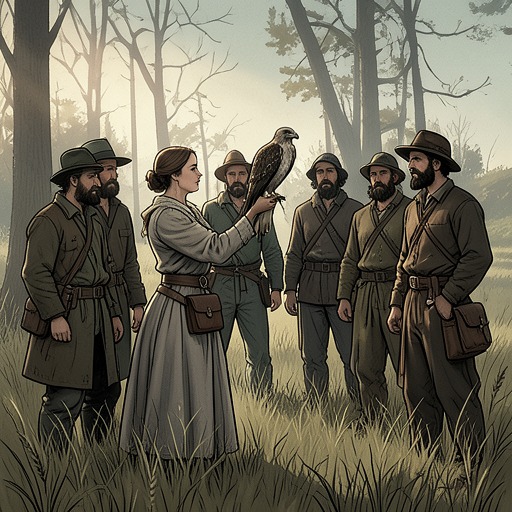
Fifteen days after Mabel arrives, the college grounds also become an unlikely social stage. Macdonald walks to a summer lunch at the Master’s Lodge, dressed in presentable clothes and carrying Mabel. At the long garden table she gives an impromptu account of falconry while the hawk tears at a rabbit leg. The invitation came from the Master’s wife, who had met Macdonald after calling to her in the street and asked her to bring the bird. The lunch draws the trained hawk into a family gathering and makes Macdonald’s new expertise visible to people from the college community.
Yet the gathering does not simply restore Macdonald to her former academic identity. Watching the guests respond to Mabel, she feels that she is no longer the Research Fellow she once was but a hawk woman, a role that seems to eclipse her previous self. The scene’s refinement and social ease feel unreal to her, while the hawk and the wasps circling her remain insistently present. Cambridge’s institutions can offer recognition and companionship, but at this point Macdonald experiences that recognition as a transformation that has displaced an earlier version of herself.
A View from Above and a Changing Sense of Home
As winter deepens, Macdonald begins to take pleasure in the morning sky for its own appearance rather than assessing it only for wind speed, direction, and likely rain. She contacts old friends, makes plans, looks for a house to rent, and returns to the doctor to discuss her progress. The change is gradual, and her doctor explains that the heavy, blurry tiredness she has experienced is a side effect of medication that should pass. Her attention is no longer fixed exclusively on the requirements of flying Mabel.
The relationship between hawk and falconer also begins to rebalance. Macdonald recognizes that Mabel’s world and her own are not the same, despite having once felt that they were. She permits the hawk to range more widely and to pursue opportunities in the landscape, even though she knows this departs from conventional advice. The developing distance between them is not simply a loss of attachment; it accompanies Macdonald’s return to other relations and future plans.
From a hill in the Cambridgeshire countryside, Cambridge appears small and mild, its roads and walls partly concealed by trees. Macdonald compares the rooftops and spires to a miniature town that might be moved like a chess set. She increasingly parks on the open-air fourth floor of a multistorey car park to look toward the fields, where copses and cloud-shadow mark the horizon. The elevated view produces a doubling: she feels herself on the distant hill even as she stands among concrete and traffic in the city. The two places are not separate worlds so much as competing locations of attention.
The hill becomes home through repeated, particular knowledge. Macdonald knows its hedgerows, tracks, rabbit runs, rusted machinery, muddy enclosure, and fields as they change with cultivation and season. From the city, the countryside can be seen as a broad prospect; from the hill, it is made up of named or recognizable features encountered at close range. Cambridge’s significance in the memoir rests partly on this movement between distances. It remains a city of college work and social life, but its meaning is altered by the surrounding land and by Macdonald’s changing relation to Mabel, grief, and the possibility of a future beyond the hawk.